How many people does it take to manage a 500 crore mutual fund practice?
Not 50. Not 20. Not even 10.
Three.
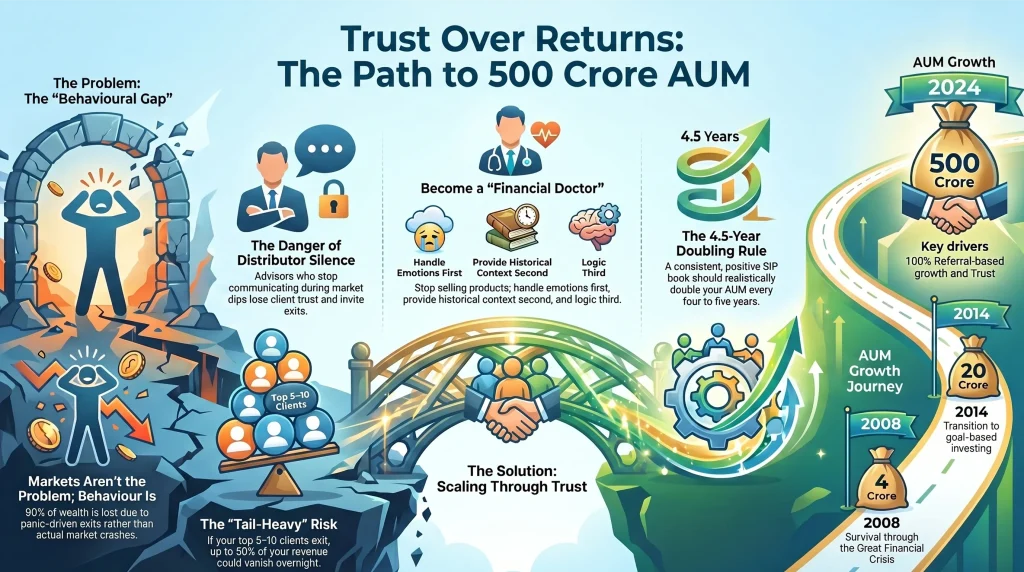
Ram Krishna Gaikwad from Pune manages 500 crore across 3,000 clients with a team of three and zero cold calling. He started from nothing, no finance background, no network, no inherited book of clients.
We hosted him on Investwell Insider to understand exactly how he got here.
These insights come from Session 3 of Investwell Insider, a series we run exclusively for our client community. Each session brings in an established distributor/advisor from within the community to share their experience & learnings.
The Market Was Never the Problem

Markets have recovered from every crisis in history. 2002. 2008. 2020. Every single time.
If the market were the actual problem, wealth creation through mutual funds would not exist. But it does, reliably, for those who stay invested.
So what fails? Behaviour. Almost always.
Four patterns cause clients to exit:
Panic selling: When markets fall sharply, driven by fear rather than any change in their actual financial situation.
Goal shifting: The original reason for investing quietly gets replaced by a short-term reaction. The child’s education fund suddenly becomes an emergency exit.
Crowd mentality: Clients chase whatever performed last. Small cap last year, gold this year, momentum next. Always arriving late.
Overconfidence: A client who has seen a few good years starts believing they can time the market themselves.
Each of these is a behavioural problem, not a market problem. And each one requires a different response from the advisor.
Think of it the way a doctor would. A patient who walks into a clinic and says, “Doctor, please prescribe me this specific medicine” is not getting that prescription from a good doctor. The doctor diagnoses first. The prescription follows. An advisor who simply executes what a panicking client demands is not advising. They are processing. The job is to diagnose first.
Your Only Real Product Is Trust

Every AMC offers broadly similar products. The fund universe is not what differentiates you. What keeps a client with you specifically, through market cycles, through volatile periods, through better offers from competitors, is trust.
What breaks trust fastest is over-promising. Claiming 15% or 20% returns to win a client creates an expectation no market can consistently meet. When reality arrives, the client does not blame their own expectations. They blame you.
The alternative is not underselling. It is honest benchmarking. If a client’s money is sitting in an FD earning 6-7%, showing them that even a conservative equity allocation has historically delivered 2-4% more over the long term is a compelling case without a single false promise.
A healthy benchmark: AUM should double every 4 to 4.5 years. If yours is not, the gap is rarely the market. It is almost always trust.
Build Your SIP Book Like a Business Asset

A SIP book is not just a revenue metric. It is the most stable part of your business.
A strong SIP book creates predictable, recurring capital. It absorbs redemptions, funds new investments, and keeps your business moving even in months where nothing new comes in. The bigger and stickier your SIP book, the less dependent you are on constantly chasing fresh capital.
What makes a SIP book sticky is not the amount. It is the reason behind it. A SIP labelled “Riya’s college fund” behaves very differently from an unnamed monthly deduction when markets turn volatile. When a client considers stopping, the conversation shifts from NAV to Riya’s college. That is a much harder decision to make. Goal tagging turns a financial transaction into a personal commitment, and personal commitments are far harder to abandon.
The Behavioural Coach Playbook

The job is not to sell products or predict markets. It is to manage behaviour. Three things make that possible in practice:
Be Available: During volatile markets, silence is the most expensive mistake an advisor can make. A client who cannot reach you during a crisis does not just get anxious. They find someone else. Even a brief WhatsApp message during a sharp fall, not a prediction, just a steady presence, is enough to hold the relationship.
Communicate Consistently: Regular updates when markets are up, down, or flat. Short videos in your own language. A weekly message that shows you are across things. The tools exist. The discipline to use them consistently is what separates practices.
Retention Before Acquisition: 80% of your energy on keeping existing clients, 20% on new ones. Losing two clients and replacing them with two new ones is not growth. It is running on a treadmill.
When it comes to referrals, the approach that works is specific. Ask a happy client to imagine a version of their life where they had met you ten years earlier. Then ask: do you have someone in your life who could benefit from that same head start? That ask does not feel like a sales pitch. It feels like genuine concern for someone the client cares about.
Conclusion
One line from the session captured everything:
“Returns build wealth. Behaviour protects it.”
A 500 crore practice is not built on the back of the best-performing funds. It is built on clients who stayed invested through 2008, through 2020, through every period where leaving felt like the rational choice. They stayed because someone they trusted told them to.
That is the job. And when you get it right, the practice builds itself.
Staying on top of your entire client book, knowing which SIPs are at risk, which clients need a call, and which goals are approaching, is what makes proactive advising possible at scale. That is what Investwell Mint is built for.
Webinar Speaker
Ram Krishna Gaikwad is the Founder of Ram Gaikwad Finserv Pvt Ltd, based in Pune. He manages 500 crore in AUM across 3,000 clients with over two decades of experience in the profession. He is the author of Phoenix Rising – Slum to Millionaire (Autobiography), along with two other books. He is also a motivational speaker whose work continues to inspire advisors across the community