What To Say When Markets Fall & Clients Call
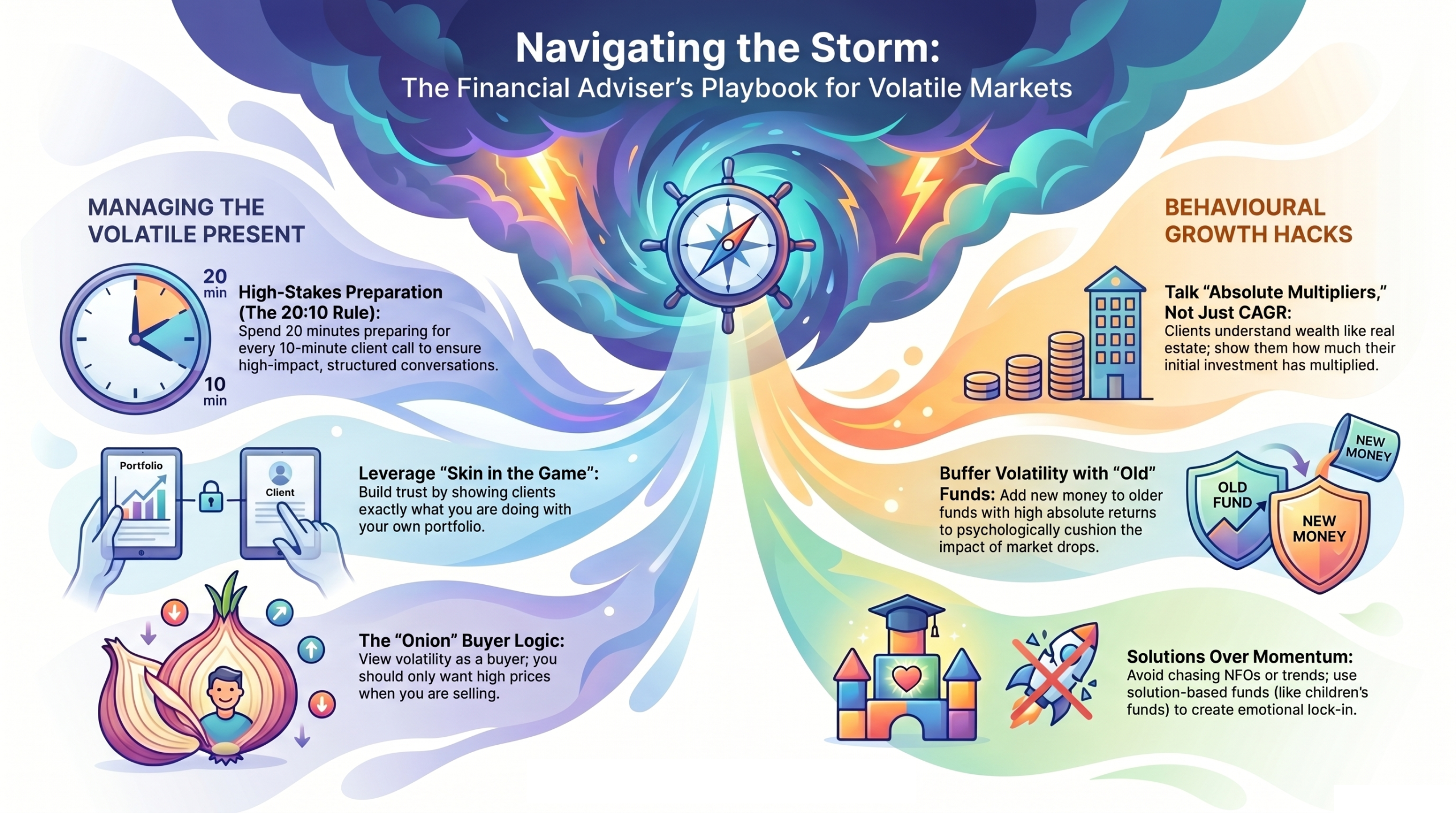
Sensex drops 800 points, clients’ portfolios are red, and the phone starts ringing.
Even the most disciplined long-term clients sound anxious, and advisors often find themselves sounding defensive.
With recent market swings driven by global geopolitical tensions, this pattern is playing out more frequently.
The good news? Most advisors make the same handful of mistakes during a storm. Which means if you avoid them, you’re already ahead. Below is a guide to tackling panicking clients in volatile markets.
These insights come from the first session of Investwell Insider, a series we run exclusively for our client community. At Investwell, our clients are our community, and sessions like these are our way of giving back. Each session brings in an established distributor/advisor from within the community to share their experience & learnings. The first speaker was Mr. Subir Jha, Founder of BuckSpeak Pvt Ltd, Hyderabad, managing over ₹550 crore in AUM.
The Foundation of First Principles and Passion
Before addressing a client, an advisor must solidify their own internal game.
First Principles Thinking: Every professional decision should stem from “First Principles”. This is reached by repeatedly asking the “Why” question until the answers stop.For example, instead of recommending a fund based on recent performance, ask: Why this fund? Why this exposure? Why this allocation for the client’s goal and risk capacity? Keep asking until the answer shifts from product to need. Where the “why” stops is the first principle.
Passion as a Buffer: This profession requires a high level of passion, especially during downturns. Passion is defined as the force that takes care of your bad days at work. Without it, the friction of a volatile market leads to burnout; with it, the “bad days” become manageable parts of a larger mission.
Finding the "Right Foot"

In a volatile market, your posture dictates the client’s reaction. It is critical to avoid two common extremes: being on the “back foot” (defensive and apologetic) or the “front foot” (over-aggressive). Instead, maintain the “Right Foot” stance – being correctly positioned as a professional who provides a diagnosis, not just a product.
Engage consistently across platforms like WhatsApp, LinkedIn, Instagram, and meetings, but avoid reacting to every minor market dip, as frequent responses to small declines can appear reactive rather than strategic.
Do not fall into the prediction trap; it is both professional and credible to admit uncertainty about short-term events, while focusing clients on the higher probability of long-term returns.
Use periods of market stress to share insights from fund managers and CIOs, but translate these into clear, simple language that clients can understand.
Equally important, treat communication as a two-way process by allowing clients to express concerns before responding. Listening first ensures that your advice is relevant and more likely to be accepted.
Reframe Volatility Using "The Onion Story"
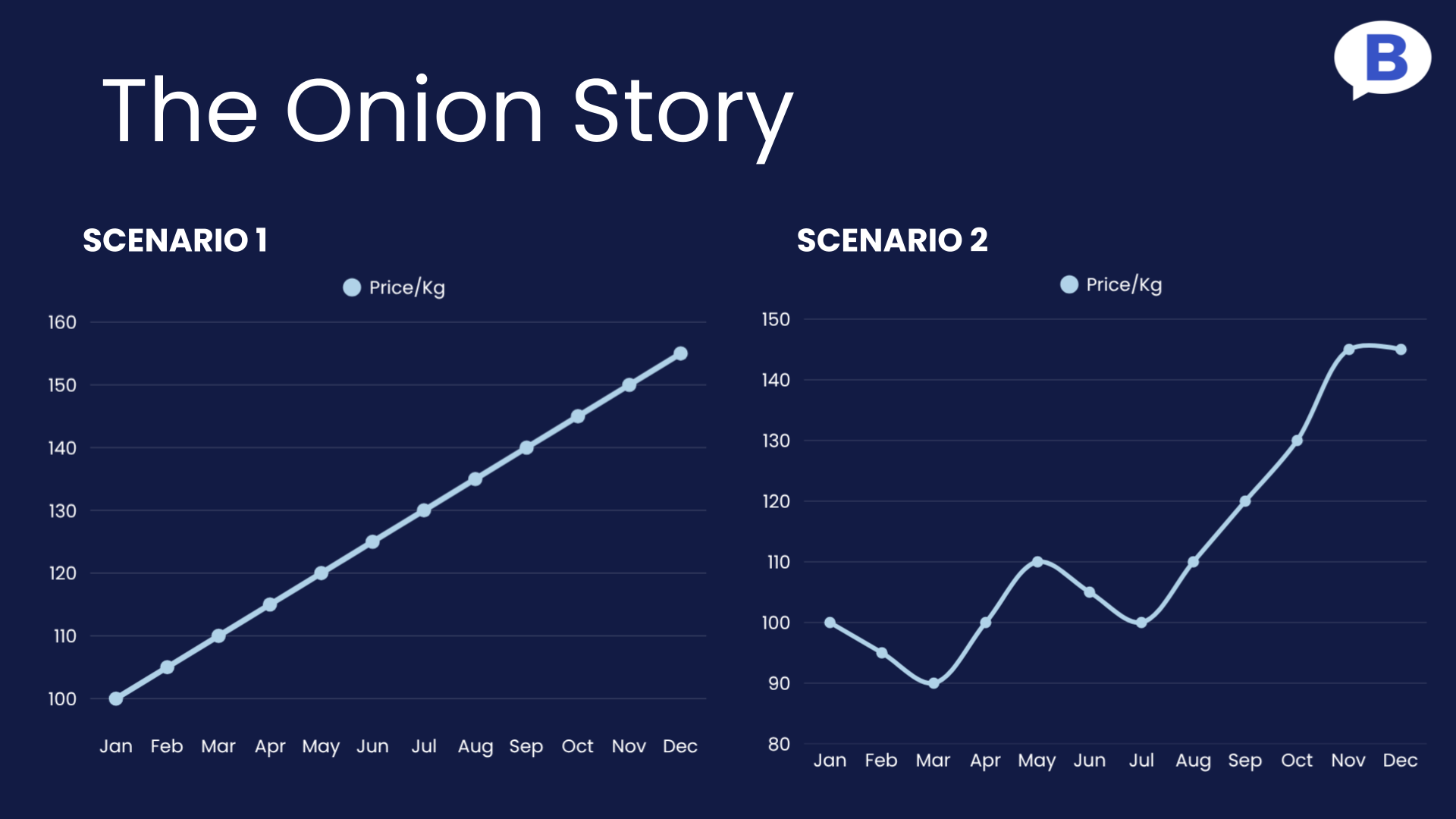
Most clients panic during market dips because they view themselves as sellers, even when they are still buyers through their SIPs. Subir’s way of reframing this is a framework called The Onion Story:
The Scenario: Imagine you are an onion trader who needs to buy 120kg of onions over a year to sell in the 13th month.
The Logic: As a businessman, you should prefer lower prices during the buying phase so your average cost is lower.
The Lesson: Teach your clients that low prices are “buying prices” and high prices are “selling prices”. They should only desire high prices on the day they exit; during the accumulation phase, a rising market is actually an enemy that increases the cost of their future wealth
Speak in rupees, not percentages
Technical metrics like CAGR, Alpha, and Beta are necessary for making “apple-to-apple” comparisons between funds, but they often lack the emotional resonance needed to build long-term conviction. Even the most sophisticated investors – including tech-industry CEOs and CTOs – rarely know the CAGR of their personal assets. Instead, they find joy and certainty in “Absolute Multipliers”.
The Real Estate Benchmark: Consider how people view property wealth. A homeowner almost never says their apartment delivered an 8% CAGR over 15 years. Instead, they say, “I bought this for ₹90 lakhs, and it is now worth ₹3 crores”. They understand and value how many “times” their money has grown.
The Language of Joy: In your client reviews, once a fund has a history of three to five years, shift the focus from percentages to absolute growth. Use clear, powerful statements like: “Your initial investment of ₹20 lakhs is now worth ₹45 lakhs”. Seeing a multiplier (e.g., 2.25x) provides a psychological satisfaction that an abstract percentage cannot match.
The “₹5-Crore” Difference: Use absolute figures to explain the “cost” of being too conservative. Over a 20-year period, a ₹1-crore investment growing at 8% (typical for fixed-income assets) becomes ₹4 crores. However, at 12% (typical for equity), it becomes ₹9 crores. Framing the risk/reward as a ₹5-crore difference rather than a “4% difference” makes the value of staying invested in equity tangible and undeniable for the client.
By translating technical performance into the intuitive language of wealth, you help clients view their mutual fund portfolio with the same long-term “buy-and-hold” conviction they usually reserve for real estate.
Conclusion: Skin in the Game
The ultimate validation of professional advice is transparency. There is no stronger conviction than showing a client your own portfolio… your own moves, eg: “I am not closing my SIPs; I am actually moving money into equity myself”. This “Skin in the Game” proves you aren’t just a salesman, but a practitioner of your own advice.
Remind your clients: They can listen to influencers or journalists, but they can only confront you. That high level of accountability is why they should trust your stance over short-term noise.
And if you want to take that transparency one step further, give your clients a window into their own portfolio in real time. When they can see their numbers clearly, the noise outside gets quieter. Investwell Mint makes that possible.
Author Bio

Mr. Subir Jha is the Founder of BuckSpeak Pvt Ltd, a boutique investment management firm based in Hyderabad, managing over ₹550 crore in AUM. After completing his MBA from NMIMS, Mumbai in 2006, he worked with Kotak Mahindra Bank in investment management for HNIs and NRIs. He has been featured in Mint, The Hindu, The Economic Times, and on CNBC TV18.
FAQs
How do I handle client calls when the market falls sharply?
The best thing you can do is not wait for the phone to ring. Reaching out first already puts you in a different position. When you do speak, let them talk before you do. Most clients just need to feel heard before they are ready to listen. Once they are, bring the conversation back to where they were headed, not where the market is.
How do I convince a client not to stop their SIP during a market correction?
It helps to remind them which side of the transaction they are actually on. Someone running a SIP is still in buying mode, not selling mode. So lower prices are quietly working in their favour, giving them more units at a lower average cost.
What do I say when a client asks me to predict when the market will recover?
“I don’t know” is one of the most credible things you can say. Clients can sense when someone is guessing. What builds trust is staying confident about the long-term direction while being honest about short-term uncertainty. That combination is harder to argue with than any prediction.
My client does not understand CAGR or percentages. How do I explain fund performance?
Most people, even sophisticated ones, do not actually think in percentages when it comes to their own wealth. They think in rupees. So instead of talking about CAGR, try saying “your ₹20 lakhs has grown to ₹45 lakhs.” The same information lands very differently, and conviction tends to follow.
How do I build client trust during volatile markets as an MFD?
- Nothing works quite like showing your own hand. When a client hears “I have not touched my own SIPs, in fact I am adding to equity right now,” it carries a weight that no market note can match. Your personal conviction is your strongest argument.


